




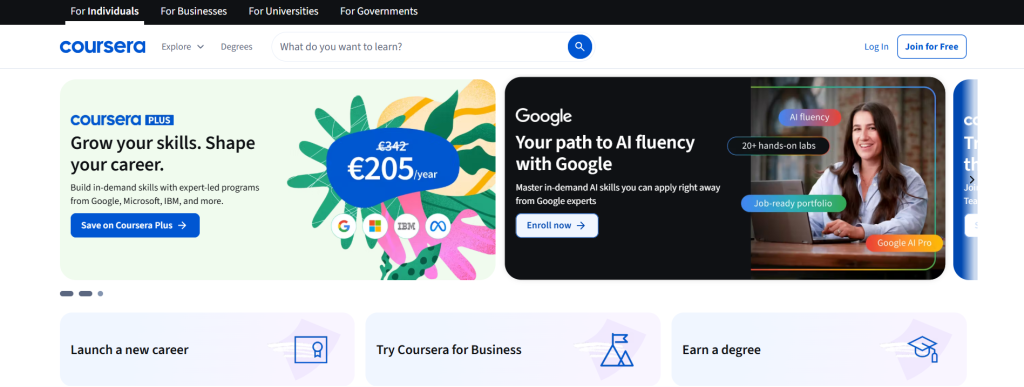
Coursera has announced an expansion of its AI-powered course builder, a development aimed at accelerating the creation and deployment of professional certificate programs across its platform. The update introduces enhanced automation tools that assist educators and partner institutions in structuring course content, generating assessments, and organizing learning pathways more efficiently. According to information available on Coursera’s official website, the feature is designed to reduce development timelines while maintaining academic and instructional standards. The initiative reflects Coursera’s broader focus on integrating artificial intelligence into its learning ecosystem to support both educators and learners. The expansion also aligns with increasing demand for workforce-oriented training programs, particularly in areas such as data science, artificial intelligence, and business analytics.
Coursera Introduces AI Tools for Faster Course Development
Coursera has integrated advanced AI tools into its course development framework, enabling faster creation of educational content for its global audience. The platform now provides automated suggestions for course outlines, lesson structures, and quiz generation, helping instructors design comprehensive programs with reduced manual effort. These tools are particularly relevant for institutions and organizations that aim to launch new courses in response to rapidly changing industry demands. Coursera’s AI capabilities also include content recommendations based on existing successful courses, allowing developers to align their offerings with proven learning models. This approach supports consistency in course quality while enabling scalability across different subject areas. The introduction of these tools highlights Coursera’s ongoing investment in technology-driven solutions that enhance efficiency and accessibility within online education, reflecting broader trends in digital learning innovation.
Coursera Expands Professional Certificates Portfolio


Coursera continues to expand its portfolio of professional certificate programs, focusing on career-oriented learning pathways developed in collaboration with industry partners. The platform features certificates designed to equip learners with practical skills that align with current job market requirements. Recent additions include programs in fields such as cloud computing, cybersecurity, and project management, reflecting areas of sustained demand. Coursera’s professional certificates are structured to provide flexible learning options, allowing users to progress at their own pace while gaining recognized credentials. The expansion of this portfolio is supported by the newly enhanced course builder, which enables faster rollout of new programs. By increasing the availability of industry-aligned certifications, Coursera aims to support workforce development and provide learners with opportunities to enhance their employability in a competitive global market.
Coursera Strengthens Partnerships with Universities and Companies
Coursera has continued to strengthen its partnerships with universities and corporate organizations, a strategy that underpins its content offerings and platform growth. The company collaborates with leading academic institutions and industry leaders to develop courses and certification programs that combine theoretical knowledge with practical application. These partnerships enable Coursera to deliver a diverse range of subjects while maintaining credibility and relevance in its course catalog. The expansion of AI-powered tools further supports these collaborations by simplifying the process of course creation for partners. Coursera’s partnership model also facilitates the integration of real-world case studies and industry insights into its programs, enhancing the overall learning experience. This approach reflects the platform’s commitment to bridging the gap between education and employment through collaborative content development.
Coursera Enhances Learner Experience Through Platform Updates


Coursera has implemented several updates aimed at improving the overall learner experience, focusing on usability, personalization, and accessibility. The platform now features enhanced navigation tools, personalized course recommendations, and improved progress tracking systems. These updates are designed to help learners identify relevant courses more easily and monitor their learning outcomes effectively. Coursera’s interface improvements also include mobile optimization, ensuring that users can access content seamlessly across devices. The platform leverages data-driven insights to tailor recommendations based on individual learning patterns, supporting a more customized educational journey. By refining its user experience, Coursera aims to increase engagement and retention while maintaining its position as a leading provider of online education services in a competitive digital environment.
Coursera Aligns Offerings with Global Workforce Trends
Coursera’s recent developments reflect its alignment with global workforce trends, particularly the growing demand for digital skills and continuous learning. The platform’s focus on professional certificates and skill-based courses is driven by the need for upskilling and reskilling in a rapidly evolving job market. Coursera’s content strategy emphasizes areas such as artificial intelligence, data analytics, and technology management, which are increasingly relevant across industries. The integration of AI tools into course development further supports this alignment by enabling the rapid creation of programs that address emerging skill gaps. Coursera’s approach demonstrates an understanding of the shifting dynamics of employment, where lifelong learning has become essential for career progression. By aligning its offerings with these trends, the platform continues to play a role in supporting workforce readiness on a global scale.
Coursera Expands Global Reach Through Localized Content

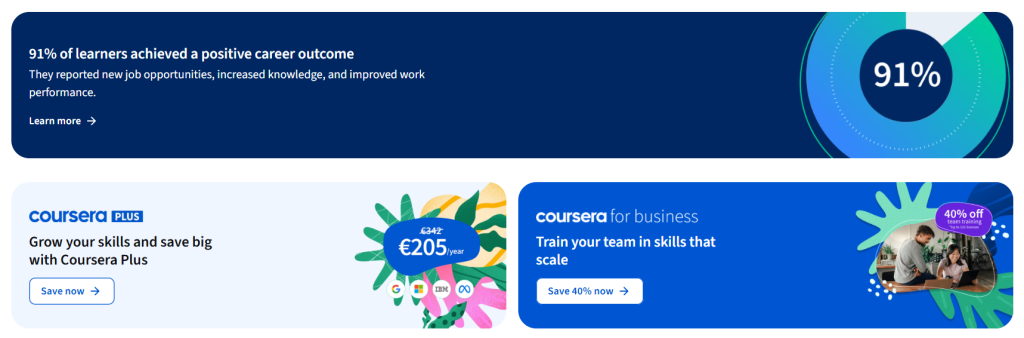
Coursera has expanded its global reach by introducing localized content and language options to cater to diverse audiences. The platform offers courses in multiple languages and provides subtitles and translated materials to improve accessibility for non-English-speaking learners. This localization strategy enables Coursera to serve a broader user base while addressing regional educational needs. The company also collaborates with international institutions to develop content that reflects local contexts and industry requirements. Coursera’s efforts to diversify its offerings support its mission to provide universal access to high-quality education. By expanding its global footprint, the platform continues to attract learners from different regions, contributing to its growth and influence in the online education sector.
Coursera Invests in Technology to Support Scalable Learning
Coursera’s latest updates highlight its investment in technology aimed at supporting scalable learning solutions for millions of users worldwide. The integration of AI-powered tools, enhanced platform features, and expanded course offerings reflects a comprehensive approach to digital education. Coursera’s infrastructure is designed to handle large volumes of learners while maintaining performance and reliability. The platform’s focus on scalability is particularly important as demand for online education continues to grow across different demographics. Coursera’s technology investments also include data analytics capabilities that provide insights into learner behavior and course effectiveness, enabling continuous improvement. These developments indicate an ongoing effort to build a robust and adaptable learning ecosystem that can support future growth and innovation within the digital education landscape.